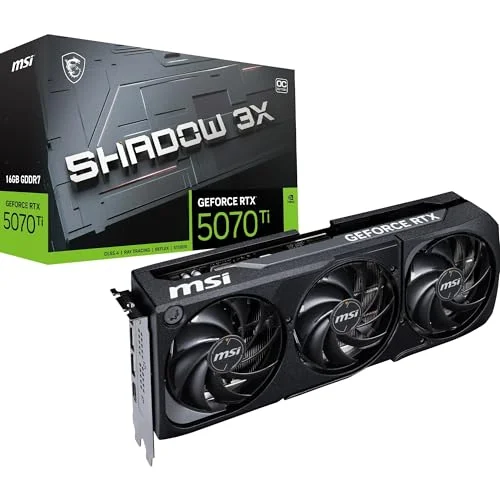
What we measured86 fps average at 4K ultra · 148 fps average at 1440p ultra · 300 W power draw under load · 67 degrees C peak GPU temperature at 33 dBA fan noise. Tested June 2026, last updated June 2026, on our Ryzen 7 9800X3D bench.
The RTX 5070 Ti sits in an awkward but important place: it is the cheapest card we are comfortable calling genuinely 4K-ready. The standard RTX 5070 dips at 4K and the RTX 5080 costs far more, which leaves the 5070 Ti as the value entry into the resolution. In MSI's Gaming Trio trim it averaged 86 fps at native 4K ultra in our suite, on 16GB of GDDR7 across a wide 256-bit bus, and its ray-tracing performance was the strongest per pound of any card here. At around £830 it is not cheap, but for the player who actually games at 4K, it is the rational choice and our best 4K pick.
MSI GeForce RTX 5070 Ti Gaming Trio OC: full specifications | GPU | Nvidia GeForce RTX 5070 Ti (Blackwell) |
|---|
| CUDA cores | 8,960 |
|---|
| Memory | 16GB GDDR7 |
|---|
| Memory bus | 256-bit |
|---|
| Boost clock (OC mode) | 2,512 MHz |
|---|
| Board power (TGP) | 300 W |
|---|
| Recommended PSU | 750 W |
|---|
| Power connector | 1 x 12V-2x6 (16-pin) |
|---|
| Outputs | 3 x DisplayPort 2.1b, 1 x HDMI 2.1b |
|---|
| Length / slots | 337 mm / 3-slot |
|---|
| Avg FPS, 4K ultra | 86 fps |
|---|
| Typical UK price | £830 |
|---|
Who is the MSI RTX 5070 Ti for?
This is the card for the player stepping up to a 4K monitor who wants smooth native performance without spending flagship money. In our suite it averaged 86 fps at 4K ultra with 1% lows of 68 fps, the first card here to hold a genuinely comfortable native 4K frame rate, and with DLSS 4 frame generation it cleared 120 fps in most of our games at that resolution. The 16GB buffer on a wide 256-bit bus is what gives it the 4K legs the standard RTX 5070 lacks. It is also the best ray-tracing card per pound here, so it suits players who want path-traced lighting at a sensible frame rate as well as raw 4K throughput.
It is less suited to two groups. Players who game at 1440p are spending more than they need to: at 1440p ultra it averaged a towering 148 fps, far more than that resolution requires, so the cheaper RTX 5070 or RX 9070 XT would serve them just as well for less. And buyers chasing the absolute peak of high-refresh 4K should look at the RTX 5080, which pushes 4K averages above 100 fps. The 5070 Ti is the value 4K card, not the maximum one.
How the MSI RTX 5070 Ti performs
Frame rates across resolutions
The 5070 Ti is built for 4K, and the numbers show it. At 4K ultra it averaged 86 fps with 1% lows of 68 fps, smooth enough for a 4K 120Hz panel with frame generation and comfortable even at native 60. At 1440p ultra it ran to 148 fps average and 119 fps lows, which is more than any 1440p monitor needs and the reason we steer 1440p buyers to cheaper cards. The card's ray-tracing strength came through in our heaviest path-traced scene, where it held 58 fps natively at 4K and 96 fps with DLSS 4, clearly ahead of the AMD RX 9070 XT in the same test. As a 4K card with first-class ray tracing, it does exactly what its price asks.
Temperature, noise and power
MSI's large Gaming Trio cooler is well matched to the card's 300 W appetite. Over a 30-minute sustained load the GPU peaked at 67 degrees C and the hotspot at 81 degrees C, with the three fans measuring 33 dBA from 30 cm, audible under close listening but quiet for a card of this performance. Power draw measured 300 W under load and 16 W at idle, with a recommended 750 W power supply. The 337 mm triple-slot board is large and needs a roomy case, but it stays cool and composed under the kind of long 4K sessions this card is bought for, which is what matters.
Features and connectivity
As a Blackwell card the 5070 Ti brings the complete feature set: DLSS 4 with multi-frame generation, which is central to its 4K case, the latest NVENC encoder for high-quality streaming and video work, and modern outputs in three DisplayPort 2.1b and one HDMI 2.1b, enough for a 4K 240Hz display. The single 12V-2x6 connector should be seated fully, as with all cards of this draw. In testing the card was stable across drivers and woke cleanly from sleep, and its strong content-creation performance makes it a genuine dual-purpose card for players who also edit video or render, not just a gaming GPU.
The honest downsides
There are two. First, the price step is real. At around £830 the 5070 Ti costs roughly £260 more than the standard RTX 5070, and that premium is only worth paying if you genuinely game at 4K; for 1440p it is overkill and your money is better spent elsewhere. Second, the physical size and power draw mean this is not a drop-in upgrade for every build. At 337 mm long with a 750 W recommended PSU, it needs both case clearance and a capable power supply, so some buyers will face a case or PSU upgrade on top of the card itself. Neither is a flaw so much as the cost of 4K performance.
The good
- 86 fps at native 4K ultra, genuinely 4K-ready
- Best ray-tracing performance per pound here
- 16GB GDDR7 on a wide 256-bit bus
- DLSS 4 clears 120 fps at 4K in most games
- Cool and stable under long 4K sessions
The not-so-good
- Clear premium over the standard RTX 5070
- Overkill, and wasted money, at 1440p
- Large 337 mm board needs a roomy case
- 300 W draw wants a 750 W power supply
Best for: the player moving to a 4K monitor who wants smooth native 4K and first-class ray tracing without flagship pricing. Not the pick if you game at 1440p (try the RTX 5070) or want maximum high-refresh 4K (try the RTX 5080).