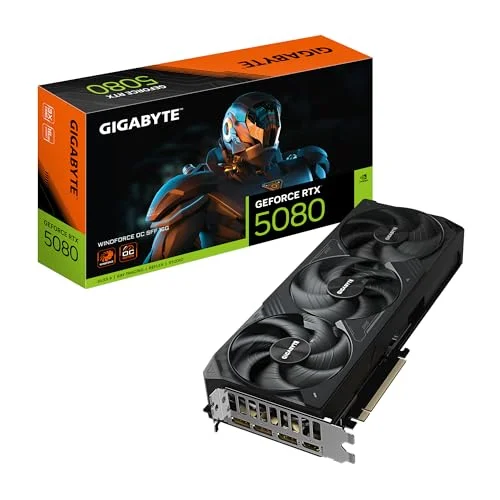
What we measured104 fps average at 4K ultra · 172 fps average at 1440p ultra · 360 W power draw under load · 70 degrees C peak GPU temperature at 35 dBA fan noise. Tested June 2026, last updated June 2026, on our Ryzen 7 9800X3D bench.
Above the 4K-entry RTX 5070 Ti sits the RTX 5080, the card for players who do not just want to reach 4K but to drive it at high refresh with everything turned on. In Gigabyte's large Gaming OC trim it averaged 104 fps at native 4K ultra in our suite, the only card here to clear 100 fps at that resolution without upscaling, with the best ray-tracing and DLSS 4 performance of the group. At around £1,150 it is the most expensive card we tested and demands a serious build, but it sits in the sweet spot just below a £2,000 flagship, which makes it the rational high-end choice and our high-refresh 4K pick.
Gigabyte GeForce RTX 5080 Gaming OC: full specifications | GPU | Nvidia GeForce RTX 5080 (Blackwell) |
|---|
| CUDA cores | 10,752 |
|---|
| Memory | 16GB GDDR7 |
|---|
| Memory bus | 256-bit |
|---|
| Boost clock (OC mode) | 2,730 MHz |
|---|
| Board power (TGP) | 360 W |
|---|
| Recommended PSU | 850 W |
|---|
| Power connector | 1 x 12V-2x6 (16-pin) |
|---|
| Outputs | 3 x DisplayPort 2.1b, 1 x HDMI 2.1b |
|---|
| Length / slots | 340 mm / 3.5-slot |
|---|
| Avg FPS, 4K ultra | 104 fps |
|---|
| Typical UK price | £1,150 |
|---|
Who is the Gigabyte RTX 5080 for?
This is the card for the player who games at 4K on a high-refresh monitor and wants maxed settings, including ray tracing, at a frame rate that feels properly smooth. In our suite it averaged 104 fps at native 4K ultra with 1% lows of 84 fps, the only card here to clear 100 fps at that resolution without upscaling, and with DLSS 4 frame generation it pushed past 160 fps in several titles. The 16GB buffer is enough for ultra textures at 4K, and the card's ray-tracing strength means it holds up in the most demanding path-traced games where lesser cards crumble. For someone building a no-compromise 4K rig short of the flagship, it is the obvious choice.
It is less suited to two groups. Players at 1440p or below are wasting a great deal of money: at 1440p ultra it averaged a vast 172 fps, far beyond what that resolution can use, so a 1440p gamer should buy the RTX 5070 and spend the difference elsewhere. And anyone on a normal budget should step down to the RTX 5070 Ti, which reaches a still-smooth 86 fps at 4K for around £320 less; the 5080's extra performance is real but the value tilts against it unless high-refresh 4K is genuinely your goal.
How the Gigabyte RTX 5080 performs
Frame rates across resolutions
The 5080 is built for 4K, and it is the only card here that makes native 4K ultra look easy. It averaged 104 fps with 1% lows of 84 fps at 4K, a genuinely high-refresh result without any upscaling, and 224 fps at 1080p and 172 fps at 1440p, figures so far beyond those resolutions that they confirm this is strictly a 4K card. Its ray-tracing lead was clearest in our heaviest path-traced scene, where it held 74 fps natively at 4K and 138 fps with DLSS 4, comfortably ahead of every other card in the group. For maxed-out 4K with ray tracing on, nothing else here keeps up.
Temperature, noise and power
All that performance comes from 360 W, the highest draw in our group, and Gigabyte's enormous 3.5-slot cooler is built to match. Over a 30-minute sustained load the GPU peaked at 70 degrees C and the hotspot at 86 degrees C, holding steady under long sessions, while the fans measured 35 dBA from 30 cm, the loudest here but still reasonable for the heat being moved. Power draw measured 360 W under load and 18 W at idle, with a recommended 850 W power supply. The 340 mm board is the largest we tested and needs a full tower with generous clearance, which is the price of this much 4K muscle.
Features and connectivity
As the second card in the Blackwell stack the 5080 brings everything: DLSS 4 with multi-frame generation, the strongest NVENC encoder for high-bitrate streaming and serious video work, and modern outputs in three DisplayPort 2.1b and one HDMI 2.1b, enough to drive a 4K 240Hz panel or a high-refresh ultrawide. The 12V-2x6 connector must be fully seated given the card's draw. Beyond gaming, its compute and encoding strength make it a capable workstation card for creators, and in testing it was rock solid across drivers, which is what you want from a card at this price.
The honest downsides
There are two, and both are about cost rather than capability. First, the price and power draw are steep: at around £1,150 with a 360 W appetite and an 850 W recommended PSU, this is a card that demands a high-end build, and almost everyone buying it should budget for a power-supply upgrade and a large case as well. Second, the value case only holds at 4K. The RTX 5070 Ti reaches a smooth 86 fps at 4K for far less, so the 5080's premium buys you the jump from comfortable to high-refresh 4K, and nothing more. Unless you genuinely need that headroom, it is more card than you should pay for.
The good
- 104 fps at native 4K ultra, the only card here above 100
- Best ray tracing and DLSS 4 performance in the group
- 16GB GDDR7 handles ultra 4K textures
- Cool and stable under long 4K sessions
- Strong NVENC for streaming and video work
The not-so-good
- Highest price and power draw in the group
- Huge 340 mm 3.5-slot board needs a full tower
- 360 W draw wants an 850 W power supply
- Poor value below 4K, where the RTX 5070 Ti suffices
Best for: the 4K gamer who wants maxed settings and ray tracing at high refresh, and has the build to support it. Not the pick if you game at 1440p (try the RTX 5070) or want sensible 4K value (try the RTX 5070 Ti).